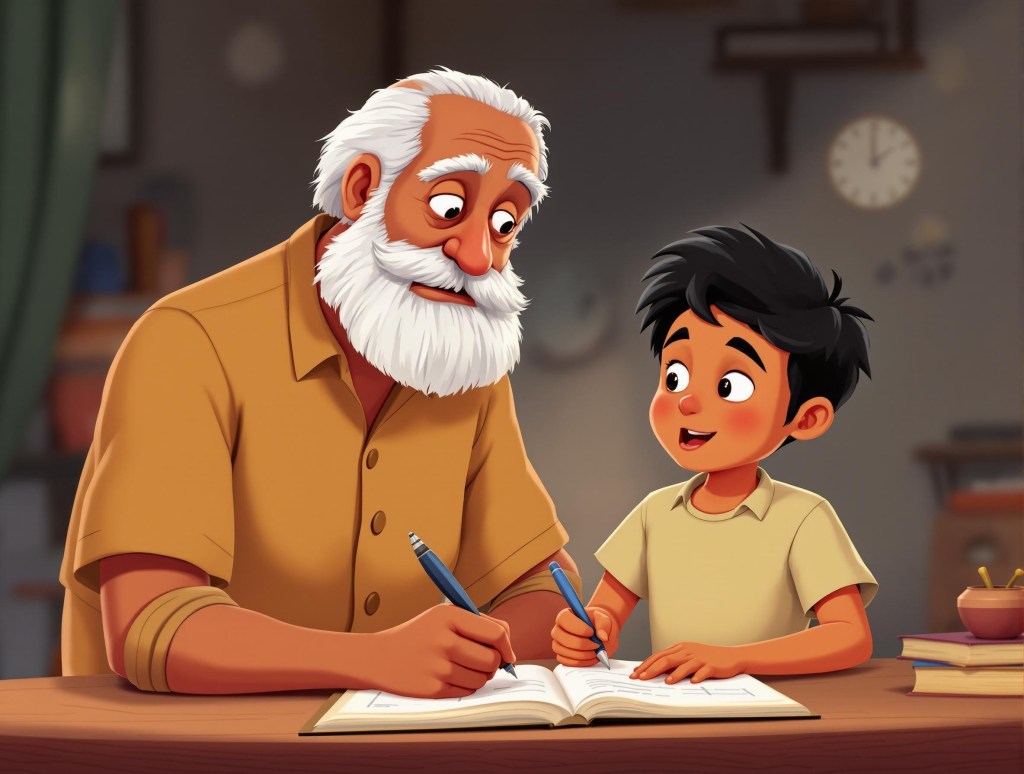
Krishna Gopal Vaishampayan, my 89 year old grandfather, was a mathematics professor in Raipur, Chhattisgargh, India. The most vivid memories I have of spending time with him are of him teaching me mathematics over the summer as a child. From quadratic equations to probability, coordinate geometry and calculus, I learned everything from him before the school year started and that always made math an easy and intuitive subject for me.
The most striking difference in his instruction was how he broke down complex concepts to their first principles. That gave me a clarity and a depth of understanding that nobody else has been able to match. While studying mechanical engineering I failed Mathematics II because they just didn’t teach us Fourier transforms and partial differential equations from first principles. My grandfather flew down to Bangalore as soon as he heard and for 2 months I studied with him every single day. When I wrote the re-examination, I don’t think I’ve ever walked out of an examination hall with so much confidence and swagger.
Every time I made a mistake in a practice problem after his instruction, especially a careless one such as forgetting about that negative sign before the brackets, I’d mentally kick myself and mumble an apology. He would invariably admonish me me in Marathi after that — गणितात चुकी साठी माफी नाही. In English that translates to “There is no forgiveness for mistakes in mathematics”.
I met him after 3 years when I visited Raipur this month. I work at the intersection of AI and product management now. When he would inevitably ask me what I was doing at work, I did not want to give as shallow an answer as “computers, the internet, artificial intelligence and product management” because those words alone wouldn’t mean anything to him. Grandfather was never one for technology. He has never used nor shown the slightest interest in a computer. But a neural network… now that’s something I could explain in a language he understood — mathematics. I had to brush up my fundamentals though. I prepared, made notes (I cannot thank 3Blue1Brown enough!). He would surely call me out if I got the math wrong.
I started by showing him a couple of examples of character recognition and language translation from an image of printed text. These were met with a “Hmm…” and seemed to compete for his interest with the muted daily soap running on the TV. But the moment I told him a mathematical model called a neural network was behind this, his eyes lit up. I knew I had his curiosity and full attention now.
Step by step I walked him through my illustrated notes on how text was recognized in images. I explained the math of layers of the network, activations, weight, biases, cost function, gradient descent and back-propagation. At 89 he is frail of body but still sharp of mind. He grasped every detail. The building blocks were all intimately familiar to him. But they were assembled in a new way that had him hooked with child-like fascination. I imagined that the constant smile on his face was equal parts amazement, delight, and pride.
The student taught the master. The circle was complete.
Grandmother was a silent observer through all of this. Once we were done with the math I showed them the many wondrous powers of ChatGPT. She quickly remarked that this would impact the brain development of children because they wouldn’t have to use it as much while growing up, leading to the dumbing down of entire generations. I didn’t have a response to that. I don’t have one now either. You might say that calculators didn’t dumb us down, but what I’ve seen ChatGPT do is orders of magnitude greater. I guess time will tell.
 Amogh Vaishampayan